


This is Part 2 of our series on verifying AI. In Part 1, we looked at how AI’s polished confidence tricks us into trusting it with trivia. Today, we tackle the higher stakes: what happens when we use these tools for work, school, and life decisions?
By now, you understand the “trust trap.” To understand why AI lies to us (and how to catch it), we need to look under the hood. We’ll start with the What, move to the How, and end with the Why.
The Mechanism of the Lie: Hallucinations
What they are
In technical terms, the AI chatbots we use today are empowered by “deep learning autoregressive models.” That’s a mouthful, but it just means they are designed to look at a sequence of text and predict the next best text to follow.
How they work
These models are built on massive architectures trained to guess the next “token” (roughly, a word or part of a word).
Take the sentence: “The CEO of Apple is…”
The model looks at its training data, billions of articles, blogs and forums, and calculates that “Tim” is the most likely next word. Then it looks at “The CEO of Apple is Tim” and predicts “Cook.”
It didn’t “know” Tim Cook is the CEO in the way you or I do. It just knew that in the history of the internet, those words appear in that order statistically often.
Why this leads to hallucinations
After doing the math, the AI doesn’t just have one answer; looking at the sequence of words “The CEO of Apple is”, it has a ranked list of probable next words.
Option A: “Tim” (90% probable)
Option B: “Steve” (5% probable)
Option C: “Sundar” (1% probable)
To make the AI sound natural and creative, it isn’t programmed to always pick the #1 answer. It has a “temperature” setting that introduces randomness. Occasionally, it grabs Option B or C just to vary the sentence structure. This is why you can ask ChatGPT the same question twice and get two different answers.
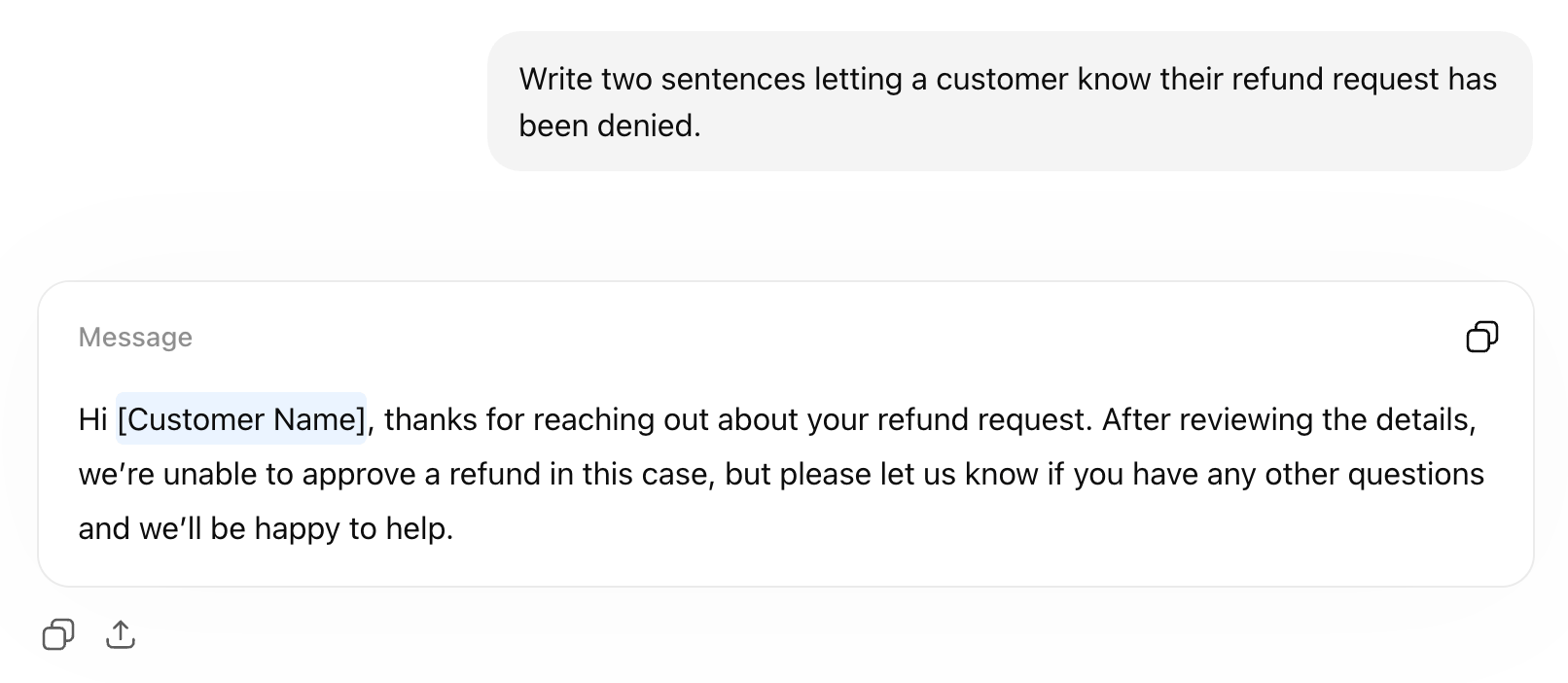
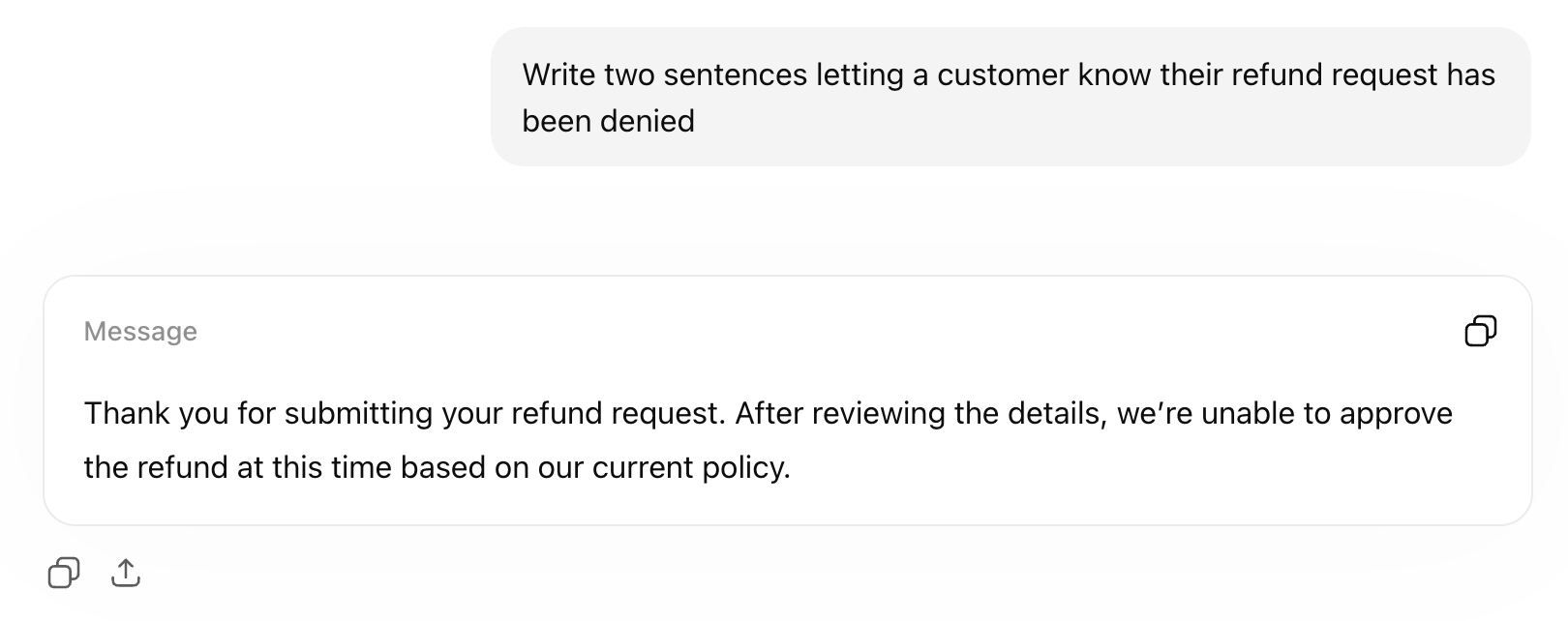
With facts, at least the mistake is findable. Harder to catch is when the model doesn’t just swap a name; rather, it swaps a consequential word, shifts a tone, or changes your underlying strategy without instruction.
Take a look at the following two responses. The prompt is identical, but the output is different. No hallucination. No wrong answer. Just two responses that handle a sensitive customer interaction in entirely different ways. One invites further debate; the other firmly closes the door.
The Danger
Here is why this matters: The model is prioritizing probability, not truth. It is trying to complete a pattern, not answer a question. Imagine you are a legislative aide using AI to draft a policy memo. In legal writing, the difference between “the agency shall enforce the rule” and “the agency may enforce the rule” is the difference between a federal mandate and a mere suggestion.
To a human, those are opposing concepts. To an AI, “shall” and “may” are just two statistically similar words that both appear frequently in legal texts. If the model’s “randomness” coin flip lands on the wrong one, you have a sentence that reads perfectly but creates a legal disaster.
What this looks like in practice
When patterns override facts, you get:
Fake Citations: AI inventing academic papers complete with plausible titles, real authors, and fake publication years because that structure “looks” like a citation.
Zombie Facts: Stating outdated information as current truth (referencing a CEO who stepped down or a restaurant that closed years ago).
Phantom Statistics: Generating precise-sounding numbers (e.g., “73% of users...”) that have no source but fit the sentence flow.
The “Expert” Lie: Confidently explaining a complex concept incorrectly in a way that is impossible to catch unless you are already an expert in that specific niche.
The Productivity Paradox
Now, all of this might make you want to swear off AI entirely. If it lies, hallucinates, and makes up laws, why bother?
Here is the twist: You absolutely should use these tools.
The goal of this series isn’t to scare you into digital celibacy; it’s to help you move from being a passive consumer to an active pilot. When used correctly, AI is still the most powerful productivity multiplier we’ve seen in decades. It can summarize in seconds what takes you hours, draft emails that clear your inbox, and brainstorm ideas when you are stuck.
The danger lies only in the blind handoff.
Productivity isn’t about speed; it’s about effective output. If you save 30 minutes writing a memo but spend three days cleaning up a PR mess because the stats were fake, you haven’t been productive, you’ve been reckless. The sweet spot is a “trust, but verify” workflow where you use AI to do the heavy lifting, but retain the role of the editor-in-chief.
We need to build a new set of digital reflexes. Just as you check your blind spot before changing lanes, you need quick, low-friction habits to check AI before you hit send.
In Part 3, we’ll cover practical strategies for catching these mistakes before they cost you.