


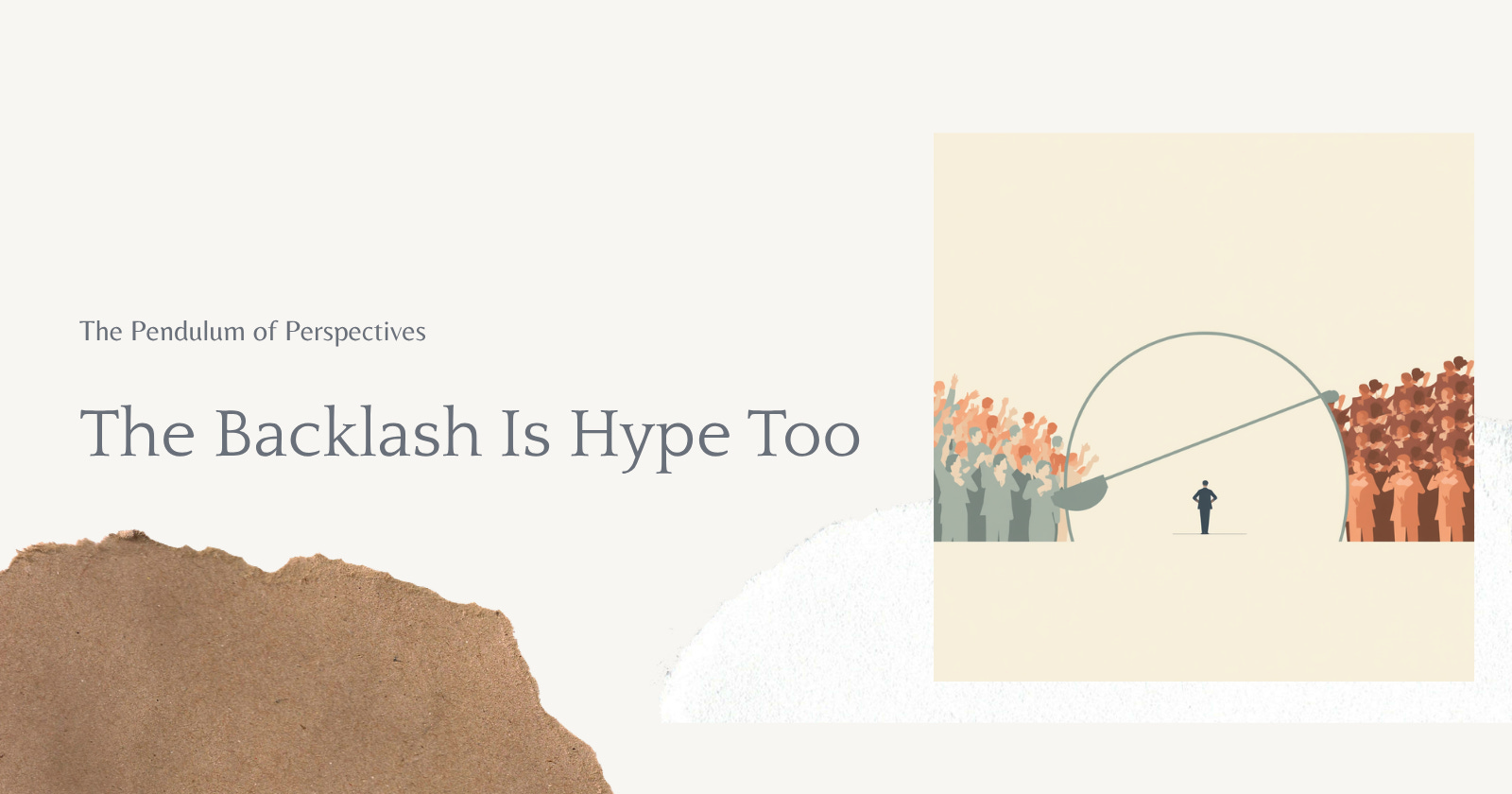
I spend most of my time here telling you to be suspicious of AI. Slow down. Check the confident answer. Don’t hand over your thinking to a machine that’s wrong with a straight face. So consider this a plot twist: today I want to stick up for it.
Not because I’ve gone soft; because the pendulum has swung so hard the other way that the criticism has turned into exactly what it claims to hate, a polished, confident story that nobody bothered to verify.
Here’s the cycle we just lived through. First came the salesmen. Every founder with a model and a pitch deck promised you the end of work, the cure for everything, a robot god by Tuesday. And look — I get it. When you’ve raised at a valuation that only makes sense if you reinvent the global economy, you kind of have to talk like you’re reinventing the global economy. OpenAI’s valuation has been speculated in the hundreds of billions of dollars (Reuters). You don’t justify a number like that with “it’s a pretty handy writing tool.”
So the dreams got sold. And predictably, the dreams curdled. Now we’re in the backlash, and the backlash has its own greatest hits, which you’ve heard at every dinner table and in every group chat: It doesn’t actually work. It’s too expensive. The companies are hemorrhaging money, so they’re never going to be real businesses, and nobody’s even using the stuff at work anyway.
Some of that is fair, and some of it is the same lazy thinking as the hype, just wearing a skeptic’s jacket. Let me take them one at a time, because the details matter, and the details are where both the cheerleaders and the doomers get caught oversimplifying.
“It just doesn’t work.”
This is the one I have the least patience for, because it’s usually said by someone who typed one vague prompt into a free chatbot in 2024, got a wrong answer, and closed the tab forever. Meanwhile, ChatGPT’s weekly active users surpassed 400 million in early 2025 (Reuters), and by May 2026 it was pulling a record 626.9 million monthly active users (Similarweb on X). Claude, Gemini, Grok, Perplexity, and Microsoft Copilot have all surged in recent months too (AI Search Traffic Report 2026). You can quibble over whether any single figure is a little off, but the scale is too big to wave away.
We also know it’s landing across the board within companies. Deloitte found 25% of organizations already have at least 40% of their AI experiments in production, with 54% expecting to reach that level within six months (Deloitte: State of AI in the Enterprise 2026). Controlled studies keep finding real gains on specific tasks: a large NBER study found generative AI raised customer-support productivity by about 14% on average, and up to 34% for newer and lower-skilled workers (NBER: Generative AI at Work). Anthropic’s own analysis of 100,000 Claude conversations estimated the studied tasks were completed about 80% faster with AI assistance (Anthropic: Estimating productivity gains). That is not a toy that “doesn’t work.”
But here’s where I won’t lie to you, because lying to you is the whole thing Toottee exists to not do: the skeptics aren’t hallucinating either. That widely cited MIT-based report suggested that most corporate generative-AI pilots (~95%) had yet to show measurable bottom-line impact (Fortune/MIT). My favorite gut-check of the whole debate comes from METR, who took experienced open-source developers, gave them AI tools, and measured them on big, messy, mature codebases. The devs felt about 20% faster. They were actually 19% slower (METR study).
Sit with that gap for a second, because it’s the most Toottee fact in this entire piece. The tool works. Your sense of how well it’s working is unreliable. “Does AI work?” is the wrong question. The right one is: for which task, for which person, and checked how? It crushes greenfield projects, drafting, and helping a junior climb a learning curve. It quietly drags when an expert already holds the whole codebase in their head. “It doesn’t work” isn’t a finding. It’s a refusal to ask the second question.
“It’s too expensive.”
This is the easiest one to wave away, and the numbers aren’t close. The cost of intelligence is in free-fall. The price to reach a given level of quality has been dropping by a median of about 50× a year, and as much as 900× a year for some capabilities (Epoch AI). It’s falling on an unusually steep cost curve. Whatever you priced AI at the last time you checked, it’s wrong now, and it’s wrong in your favor.
The honest caveat, because there’s always one, is the token-cost illusion (Artefact). Cheaper per token does not mean a smaller bill. Usage explodes, reasoning models chew through tokens like crazy, and the frontier labs are still spending fortunes on training and data centers (Sequoia: AI’s $600B question). So: “the unit price is collapsing” is true. “AI is cheap” is not. Both things exist at once.
“They’re losing money, so they’ll never be real businesses.”
Now we’re at the big one, and this is where the backlash does its sloppiest thinking. The premise is true. By analyst estimates, OpenAI is on track to lose something in the tens of billions in 2026 and doesn’t expect to turn a profit until the end of the decade (Reuters). That’s a serious estimate, and I’m not going to pretend it away.
But “losing money while scaling” is not the same sentence as “will never be a business.” Amazon lost money for the better part of a decade on purpose. The tell is that the doomers lump every AI company into one undifferentiated money-pit, and the moment you stop doing that, the story falls apart. Anthropic, by contrast, appears to have ramped up revenue quickly into the multi-billion-dollar range and has been reported to be targeting positive cash flow by 2028 (Reuters). One company burning cash on a moonshot timeline and another sprinting toward breakeven are not the same data point, and treating them as one is exactly the kind of confident oversimplification I’d want you to catch in anyone else.
Here’s the part where I switch sides, though, because the strongest version of the bubble argument deserves its due, and it’s a lot scarier than “they lose money.” The industry has lined up hundreds of billions of dollars in projected infrastructure spending against a far smaller base of current revenue, and critics argue the ecosystem is knotted up in interdependent deals where the same dollars get passed between chipmaker, cloud, and lab in a way that can make demand look bigger than it is (NPR). Even Daron Acemoglu — a Nobel economist, not a hater — says plainly that “much of what we hear from the industry now is exaggeration” (NPR). There may well be a financial reckoning. Some of these valuations are going to eat dirt.
Notice the move I just made, because it’s the whole point of this newsletter: the technology being real and the financing being a bubble are completely separate claims. The fiber-optic cable laid during the dot-com bubble didn’t stop being useful when the stocks crashed. A market can be overpriced and the underlying thing can still be one of the most important tools you’ll ever learn. Both. At. Once.
“Nobody’s actually using it at work.”
Half right, and the half that’s wrong is instructive. By any historical standard, adoption isn’t slow — it’s among the fastest any technology has ever spread. Enterprise generative-AI use roughly doubled, from about a third of companies to nearly two-thirds in two years (McKinsey). What’s actually lagging is value realization: many organizations report real friction getting it to pay off, and the most careful macro estimate we have projects the whole-economy productivity boost will be modest — on the order of half a percent over the next decade (MIT: The Simple Macroeconomics of AI). That’s not “nobody’s using it.” That’s “everybody grabbed the tool and most of them haven’t learned to use it well yet.”
Which, if you’ve been reading Toottee for more than a week, you’ll recognize as the entire reason this thing exists.
So where does that leave us?
Right back at the founding idea. The first wave of people went all-in on AI without understanding it. The second wave is writing it off without understanding it. Same mistake, opposite jersey. The hype was a story sold to you with a straight face, and you learned — correctly — to doubt it. The backlash is also a story being sold to you with a straight face. It just flatters you more, because doubt feels smarter than enthusiasm. It usually isn’t. It’s just the other flavor of not checking.
Give the technology its due. It works, unevenly. It’s getting cheaper, fast. The businesses are a genuine mess, and some of them are a bubble, and none of that tells you whether the tool in front of you is worth learning. That’s still your job to figure out, task by task, check by check.
Don’t go all in. Don’t write it off. Do the harder, less tweetable thing: actually understand the damn thing, and decide for yourself.
That’s the whole game. Always has been.